Advertisement
Grab your lab coat. Let's get started
Welcome!
Welcome!
Create an account below to get 6 C&EN articles per month, receive newsletters and more - all free.
It seems this is your first time logging in online. Please enter the following information to continue.
As an ACS member you automatically get access to this site. All we need is few more details to create your reading experience.
Not you? Sign in with a different account.
Not you? Sign in with a different account.
ERROR 1
ERROR 1
ERROR 2
ERROR 2
ERROR 2
ERROR 2
ERROR 2
Password and Confirm password must match.
If you have an ACS member number, please enter it here so we can link this account to your membership. (optional)
ERROR 2
ACS values your privacy. By submitting your information, you are gaining access to C&EN and subscribing to our weekly newsletter. We use the information you provide to make your reading experience better, and we will never sell your data to third party members.

Biological Chemistry
Shrub’s Chemistry Makes Mice Spit Seeds
Wasabi-like mustard sting thwarts animals’ seed eating, making them spit out seeds instead
by Carmen Drahl
June 25, 2012
| A version of this story appeared in
Volume 90, Issue 26
\
\
.
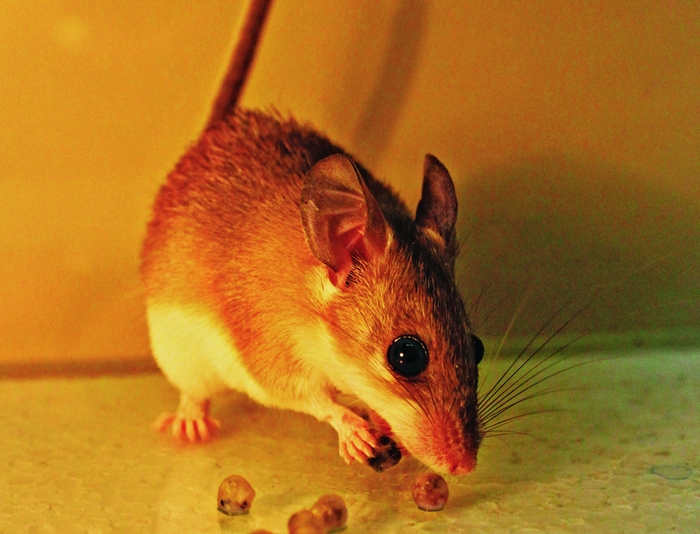
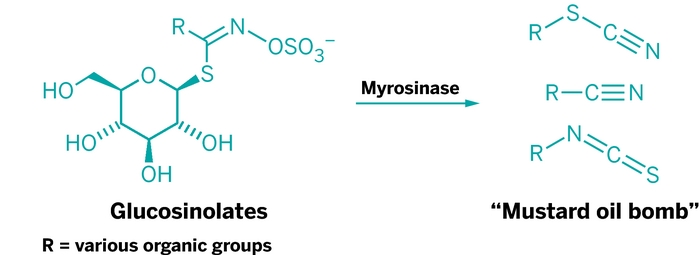
A desert shrub’s chemical arsenal tricks rodents into spitting out seeds rather than chewing them up, making the animals unwitting accomplices in the plant’s reproduction pathway, researchers report (Curr. Biol., DOI: 10.1016/j.cub.2012.04.051). Many plants use combinations of natural products to ward off predators. But this work, from Michal Samuni-Blank of Israel’s Technion, M. Denise Dearing of the University of Utah, and colleagues, marks the first time researchers have seen chemicals compartmentalized in a way that shapes animal behavior. The shrub, known as taily weed, bears sweet fruit with glucosinolates in its pulp and the enzyme myrosinase in its seeds. If an animal mashes pulp and seeds together at mealtime, the enzyme breaks the glucosinolates down to thiocyanates, isothiocyanates, and nitriles, unleashing an unappetizing, wasabi-like kick of “mustard oil.” With motion-activated cameras, Samuni-Blank watched Cairo spiny mice in the Israeli desert eat taily weed fruit and hock up seeds, presumably to avoid the mustardy sting. The rodents usually spit seeds out in rocky crevices, providing favorable conditions for germination. However, when Samuni-Blank deactivated the plant’s myrosinase in the lab, the mice changed their eating habits, feasting on both fruit and seeds.
You might also like...


The power is now in your (nitrile gloved) hands
Sign up for a free account to get more articles. Or choose the ACS option that’s right for you.
Already have an ACS ID? Log in

Join the conversation
Contact the reporter
Submit a Letter to the Editor for publication
Engage with us on Twitter