Issue Date: January 21, 2013 Web Date: January 18, 2013
Global-Warming Warnings
News Channels: Environmental SCENE
Keywords: climate change, black carbon, 2012, NOAA, NASA, global warming, combustion, coal
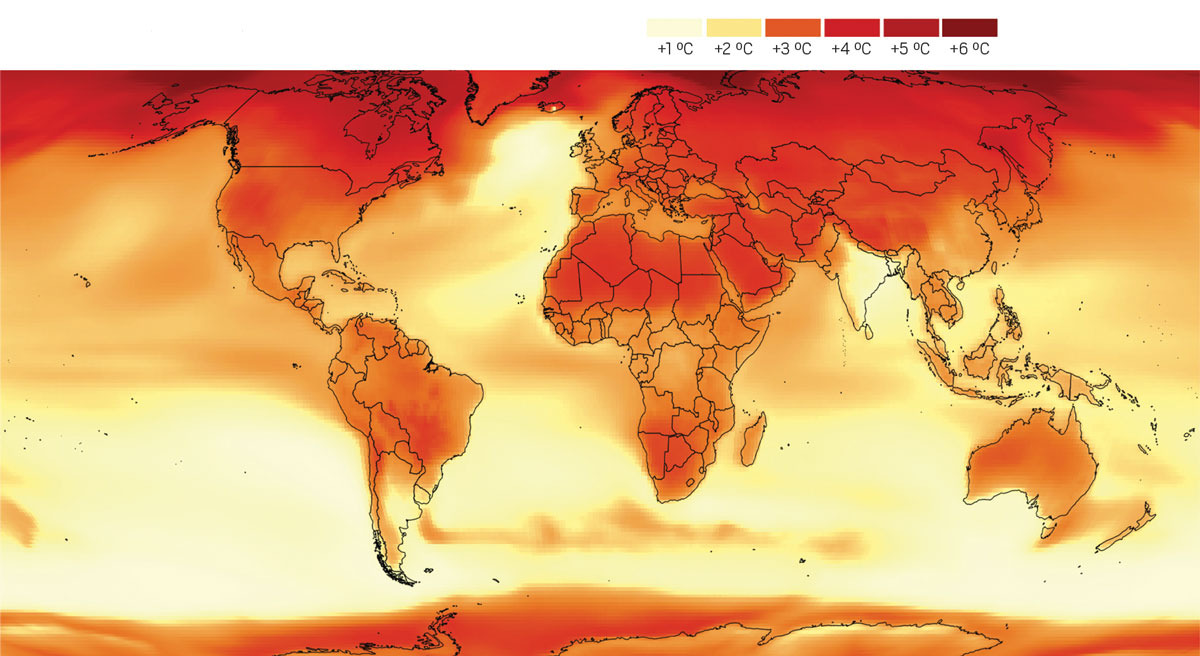
Global warming is occurring at record levels and is due to increasing atmospheric greenhouse gases generated by human activities, according to several new government scientific reports issued in recent weeks. The rapidity of greenhouse gas impacts will make projections and mitigation efforts increasingly difficult and will result in a drastic transformation of Earth’s environment, the reports say.
In a related development, researchers are reporting that airborne black carbon particles—which are a component of soot—hold twice the warming potential as previously thought.
Rising seas, heat waves, erratic and intense rainfall, storm surges, and droughts are among the effects accelerating climate changes now under way. That is one conclusion of a draft report by the National Climate Assessment & Development Advisory Committee, a 60-member federal advisory body established to advise the President and Congress on climate-change issues.
The draft assessment presents a grim picture of the ongoing impact from climate change. Looking to the future, the assessment warns of accelerating effects and the potential to reach a “tipping point” where cumulative climate extremes will exceed mitigation efforts.
The draft report, which is expected to be finalized in 2014, recommends active adaptation to a changing climate and a reduction in greenhouse gas emissions to avoid the worst cumulative climate-change impacts. It warns that scientists may no longer be able to use past climate conditions to predict future ones.
Meanwhile, analyses by the National Aeronautics & Space Administration and the National Oceanic & Atmospheric Administration show that 2012 was one of the 10 hottest years on record, on the basis of global average temperature.
Earth’s global average temperature in 2012 was about 58.3 °F, NASA says, further noting that global average temperature has risen about 1.4 °F since recordkeeping began in 1880.
Scientists from the federal agencies say the ranking of one year’s global average temperature over another is less important than the fact that 2012’s temperature is part of a warming trend that began in the late 1970s.
“What matters is this decade is warmer than the last decade, and that decade was warmer than the decade before,” explains Gavin Schmidt, climatologist at NASA’s Goddard Institute for Space Studies. “The planet is warming. The reason it’s warming is because we are pumping increasing amounts of carbon dioxide into the atmosphere.”
Another aspect of warming is the effect of airborne black carbon particles. A comprehensive analysis indicates that their climate-warming capability is double what was previously believed (J. Geophys. Res.: Atmos., DOI: 10.1002/jgrd.50171).
Black carbon particles are aggregates of carbon spherules that are produced during combustion of carbon-based fuels. They directly influence climate by strongly absorbing sunlight. When deposited on snow or ice, they reduce the reflectivity of those surfaces and cause melting. Black carbon particles also change the formation and radiation absorptive or reflective properties of clouds, with mixed warming or cooling effects.
Researchers had estimated black carbon climate effects before, but the numbers had varied, says Tami C. Bond, the study’s lead author and an engineering professor at the University of Illinois, Urbana-Champaign.
Given the large role black carbon plays in global warming and its shorter lifetime in the atmosphere compared with carbon dioxide and methane, controlling black carbon emissions could be “a short-term, immediate action that we can take to slow climate change,” Bond says.
Diesel engines and household wood and coal burning would be the best black carbon sources to control to limit warming, Bond says.
- Chemical & Engineering News
- ISSN 0009-2347
- Copyright © American Chemical Society

I burn wood in the winter to heat my home, if the government wants to buy me a new wood stove I will not stand in their way. Wahoo!
Science is not meant to be political.
If even 3 out of 10 researchers claimed an infant seat was dangerous would you buy it? But, with 97/100 experts claiming our planet is in peril, you choose to dither?
Let us hope you are not simply a Koch roach whoring for the fossil fuel companies.
Interestingly, your last sentence seems to hedge your claim that it is not getting warmer by asserting that it would be good for us if it were! Why is that?
1. Does it make sense to ignore a preponderance of evidence that lead to the conclusion by most climate scientists that human activity has had an effect on the climate until there is proof?
2. Does it make sense to invest huge amounts of money in exploration and drilling for oil when a fossil fuel economy is unsustainable?
2a. Who profits from the exploitation of this resource?
2b. From a chemists standpoint, are there better things to do with a petroleum feedstock than to just burn it?
3. From the standpoint of a resident of the planet that I, my children, and my grandchildren must live on and extract my life's necessities from, is the environmental gamble involved with extracting fuel from miles beneath the ocean surface, Canadian tar sands, Hydraulic fracturing of shale beds across the country with possible water contamination and oil spills worth the risk?
Maybe think twice about your answers. Although not proven, the possibility of climate change is very real. Remember also that while temperature cycles do indeed occur naturally, the time scale for natural variations was quite a bit longer than several decades, and it occurred when the majority of the human population were not clustered in low lying coastal regions (at least currently coastal). Don't stick your head in the sand, part of you is still exposed.
Says who?
United States Department of Agriculture
National Oceanic & Atmospheric Administration
National Institute of Standards and Technology
United States Department of Defense
United States Department of Energy
National Institutes of Health
United States Department of State
United States Department of Transportation
U.S. Geological Survey
U.S. Environmental Protection Agency
University Corporation for Atmospheric Research
National Center for Atmospheric Research
National Aeronautics & Space Administration
National Science Foundation
Smithsonian Institution
International Arctic Science Committee
Arctic Council
African Academy of Sciences
Australian Academy of Sciences
Royal Flemish Academy of Belgium for Sciences
and the Arts
Academia Brasileira de Ciéncias
Cameroon Academy of Sciences
Royal Society of Canada
Caribbean Academy of Sciences
Chinese Academy of Sciences
Académie des Sciences, France
Ghana Academy of Arts and Sciences
Deutsche Akademie der Naturforscher Leopoldina
of Germany
Indonesian Academy of Sciences
Royal Irish Academy
Accademia nazionale delle scienze of Italy
Indian National Science Academy
Science Council of Japan
Kenya National Academy of Sciences
Madagascars National Academy of Arts,
Letters and Sciences
Academy of Sciences Malaysia
Academia Mexicana de Ciencias
Nigerian Academy of Sciences
Royal Society of New Zealand
Polish Academy of Sciences
Russian Academy of Sciences
lAcadémie des Sciences et Techniques
du Sénégal
Academy of Science of South Africa
Sudan Academy of Sciences
Royal Swedish Academy of Sciences
Tanzania Academy of Sciences
Turkish Academy of Sciences
Uganda National Academy of Sciences
The Royal Society of the United Kingdom
National Academy of Sciences, United States
Zambia Academy of Sciences
Zimbabwe Academy of Science
American Academy of Pediatrics
American Association for the Advancement
of Science
American Association of Wildlife Veterinarians
American Astronomical Society
American Chemical Society
American College of Preventive Medicine
American Geophysical Union
American Institute of Physics
American Medical Association
American Meteorological Society
American Physical Society
American Public Health Association
American Quaternary Association
American Institute of Biological Sciences
American Society of Agronomy
American Society for Microbiology
American Society of Plant Biologists
American Statistical Association
Association of Ecosystem Research Centers
Botanical Society of America
Crop Science Society of America
Ecological Society of America
Federation of American Scientists
Geological Society of America
National Association of Geoscience Teachers
Natural Science Collections Alliance
Organization of Biological Field Stations
Society of American Foresters
Society for Industrial and Applied Mathematics
Society of Systematic Biologists
Soil Science Society of America
Australian Coral Reef Society
Australian Medical Association
Australian Meteorological and Oceanographic Society
Engineers Australia
Federation of Australian Scientific and Technological Societies
Geological Society of Australia
British Antarctic Survey
Institute of Biology, UK
Royal Meteorological Society, UK
Canadian Foundation for Climate and Atmospheric Sciences
Canadian Meteorological and Oceanographic Society
European Federation of Geologists
European Geosciences Union
European Physical Society
European Science Foundation
International Association for Great Lakes Research
International Union for Quaternary Research
International Union of Geodesy and Geophysics
Intergovernmental Panel on Climate Change
World Federation of Public Health Associations
World Health Organization
World Meteorological Organization
That's just wishful thinking. The earth has been warming naturally since the end of the last glaciation 20,000 years ago. In what decade did humans take over from natural warming?
Surely this is an easy question to answer.
It's like 'first we tell it's a lie.'
and if then someone present 'too much facts'...
'Hmm, let us deny that it is due to human behaviors, and further pretend that science agree with that'
Which neither of is true..
We can easily track it historically, and it's so easy to see the accumulation of CO2 in the atmosphere, and how it fits our use of fossil fuels historically.
And, believe it or not, it's not politically motivated. Mother Earth didn't decide to create a global warming to get Gore, or Hillary, as president :)
America really stands out on this issue to us Europeans, wanting it to become a 'vote able' subject.
You can't vote global warming away.
Once it is so huge to actually force you SEE it, to believe it, - suddenly it is far along and probably too late and who cares anyway?
Science shows us what we can't so easy. Facts don't lie.
Coal producing power plants pump nasty black tar into the air 24/7 - the Chinese are building 4 new ones every month - billions of tons in another couple years.... Sigh....
Just don't try to ram your life sucking carbon controls and Gaia worship down my throat thanks.
Cheers
Wind power is already less expensive, especially considering the externalities (health, etc.) of coal pollution, killing abou 26,000 per year (American Lung Assoc.)
LS
Does not mean they layers aren't there though, maybe they missed it.
As Orestes and Conway put it so well in "Merchants of Doubt", modern scientific knowledge is nothing more than a consensus of experts that began with the national academies in Italy, France and the UK. Until both the opinion and the data supporting that opinion have been subjected to peer review, it's not a reliable scientific finding.
Deniers not only have almost no peer-reviewed that support their assertions--the deniers are divided over whether GW/CC is occurring (most actually agree it is) and the extent to which it is caused by humans (the range of opinions among deniers varies widely).
Whether you measure the scientific consensus on global warming and climate change by: (1) national academies of science that have endorsed the IPCC formulation; (2) scientific rganizations in a particular discipline that have endorsed the IPCC formulation; or(3)individual scientists who have published an article on "climate change" in peer-reviewed journal that support the IPCC formulation, the expert consensus on the 3-point IPCC formulation is overwhelming:
1. It's "unequivocal" that global warming is happening.
2. It's "very likely" (more than 90% certain) that human activity is the primary cause.
3. If we continue "business as usual", it's "likely" (more than 2/3 certain) to pose dangerous risks to humans and other species.
Incoming radiation from the sun passes through that gas blanket unimpeded. When the radiation strikes solid objects on the earth surface, some of it is converted to heat. That heat has more difficulty in passing back out through the gas blanket to the stratosphere.
Since the heat can not rapidly escape from the earth's surface, nighttime temperatures are not greatly lower than daytime temperatures at any specific location. This equalization of temperature between night and day is a global warming effect, and is caused by the atmospheric gas blanket, which are global warming gases.
Carbon dioxide is said to be a global warming gas, with the implication that it is different from nitrogen and oxygen. However, when we measure heat transmission (thermal conductivity) of the pure gases (Air Gas Encyclopedia), differences are not huge. Nitrogen and oxygen each have thermal conductivities of 0.014 Btu.ft/(h.ft2.F). The thermal conductivity of carbon dioxide is 0.008. This means that carbon dioxide has almost twice the resistance to the passage of heat than do nitrogen and oxygen. In other words is a better greenhouse gas than either nitrogen or oxygen.
However, the concentration of carbon dioxide in the atmosphere is only 0.04%. At this extremely low concentration, it can have little effect in the total global warming affect of the gas mixture, even though it is twice as effective as the other components when measured at 100% concentration.
thank you